

Joanne Pasternack on The Girl Dad Show
Joanne discusses the intertwining of her work and her family on the Girl Dad Show, sharing that "it's part of what our family does and who we are."
O+R CEO, Joanne Pasternack, chats with Young Han, a self-described full-time parent and full-time professional. Through his podcast, "The Girl Dad Show,' Young interviews fellow working parents who aspire to be good at both work and parenting.
While some may try to keep the two separate, Joanne discusses the intertwining of her work and her family, sharing that "it's part of what our family does and who we are." In her work, Joanne strives to help other people elevate their voices...something she encourages her kids to do as well.
“I want my kids to apply the same ideas to their lives. It’s not just what do they want to do, but what are they meant to do.”
Watch the interview below.

Athletes' Voices and the Mother Tree
Twenty five leaders. Twenty five voices. Three days of Athletes' Voices planning, conversing and building at the stunning 1440 Multiversity campus in the Santa Cruz Mountains. Here's a peek into the retreat and info on how you can get involved in Athletes' Voices.
“A tree can be only as strong as the forest that surrounds it.”― Peter Wohlleben, The Hidden Life of Trees: What They Feel, How They Communicate
Twenty five leaders. Twenty five voices. Three days of Athletes' Voices planning, conversing and building at the stunning 1440 Multiversity campus in the Santa Cruz Mountains. The result? Awe inspiring momentum for the Athletes' Voices program as we move forward with tremendous excitement towards the December 2021 launch of the application for the inaugural cohort of the Athletes' Voices Certificate Program.
But first, let me tell you about the Mother Tree. The Mother Tree is the hub of the community where it grows, providing water and nutrients through underground connections to the other trees in her grove. The Mother Tree at 1440 Multiversity is thought to be 1,200 years old and its majestic presence is humbling.

Our convening of 25 athletes, academics, advisors, and strategists was like the root system of the Mother Tree, focused on building connections, creating a network of support, and developing a concrete plan to nourish the voices of athletes through the development of their individualize playbooks for social impact.
Collectively, we realized that the energy of collaboration, creativity, open and honest communication and the commitment to a singular goal was enhanced greatly by the opportunity to be together not just in meeting rooms but also around a drum circle, fire pit, during meals, through yoga and stargazing, and in casual, organic conversations.

We started the retreat with an idea based on a vision and left with a roadmap, individual and collective ownership and the powerful energy of a group united and inspired. And like the Mother Tree, it was an awesome sight to behold!
As we share in the Athletes' Voices vision statement - "When Athletes use their voices, the impact is exponential." If this retreat is a foreshadowing of what is to come for the Athletes' Voices program when we convene again at 1440 Multiversity from February 28 - March 3, 2022with our inaugural cohort of elite and professional athletes, the exponential impact will be transformative. I can't wait!
How can you get involved?
Attend an Athletes' Voices Speaker Series program - full schedule is available HERE
Encourage elite and professional athletes from all sports to visit athletesvoices.org and to apply for the Certificate program. Applications will be live in early-December and due in early-January and available HERE
Support our efforts! Join us as an individual donor, corporate sponsor or in-kind donor. Suggest a speaker (or nominate yourself for a speaking role) for an upcoming episode of the Athletes' Voices Speaker Series.
#SpiritLifted and #SoulWarmed. Thank you, Athletes' Voices Advisory Boards and Strategists and thank you, 1440 Multiversity. What a beautiful week.
Best,
Joanne

Joanne Pasternack on the Peace Players Int'l Play It Forward Podcast
O+R CEO, Joanne Pasternack, shares her perspective on helping professional athletes find their philanthropic mission on the Play It Forward podcast.

Our CEO, Joanne Pasternack, joins Peace Players International to share her story on their podcast, Play It Forward, with hosts Emmett Shepard and Chinny Nwagbo.
Building off of Play it Forward’s previous season's conversations with the great Alana Beard who spoke on the transition from athlete to professional, and Alisha Greenberg's insight into holding charities accountable to the communities they serve, Joanne sheds light on what it means to support athletes and help them realize they are more than just athletes.
Athletes’ Voices - https://www.athletesvoices.org/
Interested in learning more about PeacePlayers mission of growing a youth-led movement to build a more peaceful and equitable world?
Visit https://peaceplayers.org/playitforwardpodcast/ and check out social handles.
Twitter: @peaceplayers
Instagram: @peaceplayersintl and @playitforwardpodcast
Facebook: @peaceplayersintl LinkedIn: PeacePlayers International YouTube: PeacePlayers

The Play It Forward podcast is produced by: Chinny Nwagbo, Emmett Shepard, Leif Frymire
The Play It Forward podcast audio engineering and editing LeBaron Leath
Animation and music created and designed by LeBaron Leath
Podcast Cover Art by: Adam Hawkins
Marketing by: Gabriella Mora Sophie Kennedy Bailee Rasmussen

Seven questions for Joanne Pasternack, Sports Philanthropy Executive
O+R CEO, Joanne Pasternack, answers seven questions about sports philanthropy with Ade Adeniji for Inside Philanthropy.
University of Pennsylvania alumna Joanne Pasternack has spent the bulk of her career working in the realm of sports social responsibility and philanthropy. She spent 12 seasons leading philanthropic efforts for professional sports franchises in the NBA and NFL, including serving as vice president of community relations for the Golden State Warriors, executive director of the Warriors Community Foundation, and vice president and executive director of community relations for the 49ers Foundation. She runs social impact consulting firm Oliver+Rose and co-founded Athletes’ Voices at Harvard, helping amplify the voices of some of the nation’s top athletes.
We recently spoke with Pasternack about her career, the state of athlete activism and philanthropy, and perhaps most importantly, her favorite sports movie (surprise: it’s not “Rudy”). Here are some excerpts from that discussion, which have been edited for clarity.
What do you think about the philanthropy and activism of athletes today?
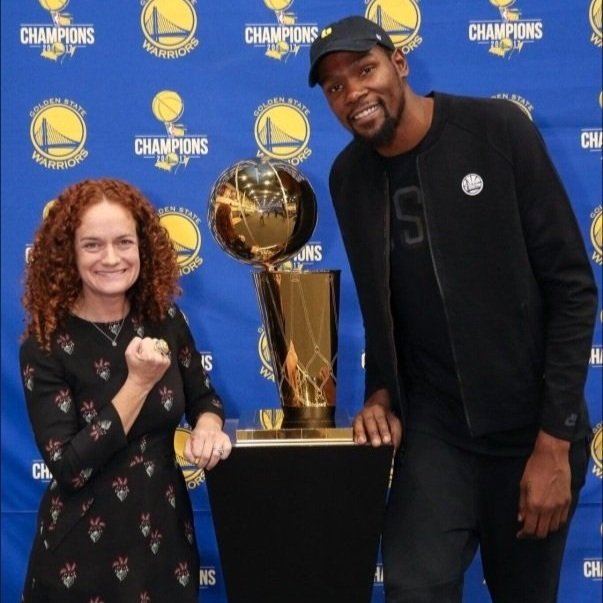
Joanne Pasternack with Kevin Durant
It’s interesting. I think that athletes have always had a platform that can amplify their voices around a cause with a much broader audience than your average individual, or even your average influencer. We look upon athletes as heroes and godlike figures sometimes.
What I’ve really enjoyed seeing over the last, maybe, 10 years is an evolution where athletes are not only acknowledging that they have a platform and they should use their voice, but they’re really thinking more deliberately about how they want to elevate their voices and what causes are most important to them.
It’s far more personal. It’s less about the performance of going out and serving food for a Thanksgiving meal. It’s more about, “I’m going to serve food for Thanksgiving meal because I experienced food insecurity as a youngster, and I want to bring visibility to that and destigmatize what it means to be in those types of situations.” To me, that’s been the biggest change.
Do you find there’s a difference in interests between professional sports leagues?
I’m really fortunate to be working with the Women’s National Football Conference and the Women’s American Basketball Association right now. And also with ladies who are affiliated with the WNBA. And I can tell you they are phenomenal. They know why they’re there. They know what they have to offer. The bravery and the boldness of speaking up and speaking out on a variety of issues is really inspirational to me.
For some of the other leagues, particularly the male leagues, the NBA, to me, has always been on the forefront of it—going way back to Boston Celtic Joe Lapchick and his son, Dr. Richard Lapchick, who led the American sports boycott of South Africa from 1975 until the end of apartheid, and was one of 200 guests personally invited by Nelson Mandela to his inauguration. Later, we have people like Steve Kerr, and how as head coach of the Golden State Warriors, he doesn’t shy away from the issues.
Even looking at vaccinations right now in the NBA—if you’re not vaccinated, you’re not getting paid. That’s a bold statement. But behind the scenes, they’re looking at what leads to vaccine hesitancy and what can be done to mitigate that by addressing cultural, historical and religiously aligned beliefs and values. They’re not negating those, but rather leaning into them and saying, “What can we do to educate and solve this problem?”
Overall, how do you think athletes go about finding the causes that they’re interested in, and who helps them?
It’s often just an issue of proximity. This is the cause that they’re closest to. Actually, I just published an article on LinkedIn [about this]. It’s usually some variation of being introduced to a cause at a team event, through what a teammate is doing, or something they’ve experienced personally—for instance, their grandmother had breast cancer or their brother was dealing with addiction. At Oliver+Rose and with Athletes’ Voices, we’re working with athletes to build out their individualized playbook for social activism so they can dig deeper and find the cause that means the most to them and to which they’re uniquely suited.
Speaking of Athletes’ Voices, why did you launch it?
We launched Athletes’ Voices because we wanted to make sure athletes were able to use their platforms and reach their intended audiences. We know that with social media, athletes are expected to comment on issues that are related to them immediately. And if they don’t, that’s also seen as commentary. So what we’re trying to do is work with individual athletes, and with teams and leagues, to identify the causes that are best aligned with their values or interests in their areas of passion and that are most authentic to them. In short, we want them to be able to say, “This is why I’m committed to this cause, and this is what I hope to do with my voice.”
We just completed the first season of our speaker series. We had 30 athletes and engaged 150,000 listeners. So clearly, there’s interest in hearing what these athletes have to say. On each of these webinars, athletes were sharing the stage with academics and seasoned practitioners. They talked about gun control. Mental health and wellness. Green sports. And more. But there was value in having the athletes, the academics, the practitioners, all sitting together and talking about this subject. We are doing our first in-person convening in March 2022. Our vision is that we have a few athletes in each sport coming together. For instance, a woman who is an Olympic badminton player, and you have a man who played in the NBA, both talking about domestic violence.
What are some of the issues you tackled through the Golden Heart Fund?
The Golden Heart Fund is looking at what life might look like for players after the NFL. What can be done to support someone who has spent their life dedicated to sports and now finds themselves on the back end of that with physical, mental, emotional and financial struggles? (Contrary to popular perception, many professional athletes experience financial distress not long after they depart or retire.) I worked with some of the most celebrated football players of all time. For them to say they were going through something, that they needed help, that they reached out and sought counseling or connected with friends and family, is really powerful. And when that fan sitting in his living room sees his idol in the football world doing it, it makes it OK for him to do it, too.
Who are some people who’ve had the greatest influence on you as a professional?
Two people, I think, outside of my father, who is my number one. First, Eunice Kennedy Shriver, who founded the Special Olympics. She didn’t believe people with intellectual disabilities were incapable of participating in athletics.
She was a “get stuff done-er.” I had the incredible fortune of working for her at the very beginning of my career at the global headquarters of the Special Olympics in D.C. And I was so inspired. She looked at me once in a meeting. I had no business even raising my hand. But I remember so vividly that she leaned across the table towards me and put her finger out and said, “Let’s see if we can’t find a way to make that happen.” That was really empowering as a 25-year old young woman coming into this world.
The other person is [Golden State Warriors] Coach Steve Kerr, because he takes the same approach. Coach is one of the most collaborative, down-to-earth, passionate people. I’ll often say this: If you think because of what you’ve seen publicly of him that he seems like a great man, he’s, like, 10 times better than that. I just don’t know that I’ve been around many leaders who are more authentic and empowering and who keep their word like he does.
We’re working on something new related to sports voices. We recorded Kerr’s segment a couple of weeks ago and were talking to him about his stance around gun violence, police brutality, defunding police and so on. And he said very beautifully that he realized that people are listening and that he had a voice. He also realized that [he could] lean into the fact that he’s not going to get fired for using his voice, that he has a degree of protection because of white privilege. He told us: “If I don’t do that, what kind of person am I?” And that’s something you don’t hear that often.
What’s your favorite sports movie and why?
Wow, that’s funny. I was just talking about this with somebody and it changes all the time. But recently I said “Invincible,” based on the story of Vince Papale, a 30-year-old bartender from South Philadelphia who overcame long odds to play for the NFL’s Philadelphia Eagles in 1976. I love the American dream scrappiness. Here’s a guy who’s been told what he can’t do most of his life. He’s like, I’m just gonna do it.
I’m really hoping that there’s going to be a movie that can tell the story of the Women’s National Football Conference, because I think that within that conference, there a hundred, maybe even more, “Invincible” stories—women who were always told what they couldn’t do and what they shouldn’t do. My client Patrick Willis, a former 49ers linebacker, and I were at their IX Cup Finals in Dallas in August. Pat turned to me and is like, “They’re ballers.” He has no children of his own yet, no nephews, but has eight nieces, and sees this as something they can grow up and aspire to be.
This article was originally published on Inside Philanthropy.

What makes you ... you? And how does your purpose influence your impact?
Creating real and sustainable social impact begins with a journey into self.
This is the first article in our series, Your Purpose, Your Ikigai, a journey to empower you to identify, develop and pursue your ikigai - your “reason for being.”
With our first post, we provide context, defining ikigai and sharing how it will lead you to your true calling professionally, personally, and philanthropically.
Ikigai is a Japanese concept meaning "reason for being," and it is the foundational element of our work at Oliver+Rose. I truly believe that living and operating in your ikigai not only leads to personal contentment but also maximizes philanthropic impact and cements your legacy. Our mission at Oliver+Rose - amplifying impact and inspiring change - is my ikigai. It is my purpose.
I spent the first few chapters of my career leading philanthropic programming for professional sports organizations - the Golden State Warriors, San Francisco 49ers, Special Olympics and the Mountain View Police Activities League. But it wasn't the excitement of gamedays nor the Championship parades I enjoyed most - I loved being in the community with the athletes and watching their eyes light up when they brought smiles to the faces of those in need. I was inspired when they found their voice, shared their story, reflected on their life learnings and related them to others, and helped someone believe in a better tomorrow. Whether it was their goal or desire or not, they were looked upon as heroes and role models - they had a platform. The key was figuring out how they were going to use that platform to maximize their ability to lift others.
Ikigai is found at the center of all things personal and important.

Ikigai is the point at the center of four rings, representing the manner through which we can find our purpose.
Ikigai is the point at the center of four rings, representing the manner through which we can find our purpose. Rings are powerful symbols in cultures around the world. They stand for partnerships, trust, excellence, happiness, the circle of life. But it is typically what is found at the intersection of the rings that bears the most value.
The four distinct questions that make up the outermost layer of the four concentric rings of ikigai are:
What do you love to do?
What are you good at?
What type of service can you provide that is of value?
What does the world need?
At the center of these concentric rings, we not only discover the manner through which we can maximum our impact but we also find personal joy, inspiration and clarity.
Connecting professional athletes with their philanthropic purpose
Through a lifelong commitment to hard work and dedication to their sport, elite professional athletes earn the unique privilege of icon and influencer status. Their talent gives them exposure and amplifies their voices. As an athlete’s audience grows, so does their ability to make real and sustainable social impact.
Athlete engagement in the community typically involves:
Participation in team-organized community events and initiatives
Contractually-based team corporate partner social responsibility programming (usually for compensation)
Individual donations to non-profit organizations affiliated with team, ownership, sponsor or teammate-related events
Hosting a gathering or social event with benefits allocated to a charitable organization
While every moment of impact makes a difference, many of the examples above represent a moment but not a movement. In comparison, involvements aligned with our reason for being - our ikigai - move us, connect us and cause us to dig deeper into our spiritual core. When we practice social impact work aligned with our ikigai, the passion, commitment, and energy are authentic and others are draw to join us in our journey. With professional athletes and influencers, this is where the true magic occurs and where a moment becomes a movement.
Letting ikigai guide philanthropic strategy
I firmly believe that for a professional athlete to achieve lasting social impact, they have to feel connected to the cause they are elevating. They have to feel energized by the cause. They have to see and feel the value of their work to support the cause. They have to be operating in alignment with their ikigai.
The most effective step a professional athlete can take at the start of their impact journey is to proactively and thoughtfully approach their philanthropic strategy, asking themselves a few key questions:
"Which cause is closest to my heart?"
"Where, how, when and why can I uniquely influence impact around the cause?"
"How equipped am I to address this issue?"
"Why me? Why now?"
"How will my involvement move others to become involved? Am I lifting the organization or the cause through my affiliation?"
Only this deeply introspective process can result in true social impact that is both personal and purposeful ... and of value to the benefitting organizations, causes or individuals.
As opposed to a calendar invite to a pre-planned event, the journey into philanthropy for athletes should follow this course:
Athlete meets with a trusted (ideally non-related and/or unbiased) advisor and creates a personal purpose inventory
Advisor researches, develops and presents recommendations for causes, organizations and platforms, working closely with the athlete to identify resonance, relevance and timeliness
Athlete develops philanthropic platform in support of selected cause - who, when, how they will support or align with the subject area
Athlete commits to the selected cause in a purposeful manner, contributing their time, passion, skills, and, where appropriate, their financial resources
Guiding others on this deeply personal journey to find their ikigai is my ikigai. Join us! Let's work together to build authentic and sustainable social impact strategies building connections between athletes, teams, leagues, governing bodies, entertainers, corporates, government agencies, non-profits and NGOs and opportunities for change.
Joanne Pasternack is the Founder + CEO of Oliver+Rose, a strategic consulting firm that brings brands, leagues, athletes and charitable organizations together to create personally meaningful and purposeful social impact.
Learn more about our favorite photographer - Terrell Lloyd - who lives his ikigai and captures the moments where athletes find theirs at @49ersofficialphotog
----

My father's journey through younger-onset Alzheimer's disease
After my father’s passing, an article was published on alzheimersblog.org to pay tribute to his life and all of the incredible things he did, both personally and professionally. I’m so happy to be able to share this incredible piece. Thank you Jennifer Tinkelenberg for honoring my father and bringing this story to life.
—

Bruce Pasternack, who is well known globally for his work as a managing partner in a prominent consulting firm, Bay Area venture capitalist and President and CEO of Special Olympics International, was diagnosed with younger-onset Alzheimer’s in 2013. His daughter, Joanne Pasternack, shares the man her father was, and how his diagnosis has led her to make changes.
From humble beginnings to working for the president
Bruce Pasternack was born in Brooklyn, New York in 1947. After graduating at the top of his class at Wingate High School in 1964, he earned a degree in Mechanical Engineering from The Cooper Union, followed by a Master of Science in Engineering from the University of Pennsylvania.
At age 26, when he was just a dissertation defense away from his PhD, Bruce joined President Gerald Ford’s staff at the White House, where he served as head of energy policy at the Federal Energy Administration and principle staff to the White House Energy Resources Council and the President’s Council on Environmental Quality. His work influenced environmental policy that is still in effect today.
Click Here to read the full article on alzheimersblog.org.